Sunday, February 23, 2014

[OT] The story of the dismembered concubine

Sex in Genesis: Is the Sodom story literal? (part 3)


The Levite finds his concubine dead on the doorstep in the morning after sending her out to be gang-raped instead of himself the night before

A husband finds his concubine dead on the doorstep after sending her out to be gang-raped instead of himself. The Benjamite rapists parallel the city of Sodom.

Just as earlier stories were used to fashion the story of Sodom and Gomorrah, a later story in the Old Testament borrowed the Sodom story as a template – using sexuality to shame a group of people. The story in Judges 19 tells of a Levite, his unfaithful concubine, and their unfortunate stay in a Benjamite city. The story follows the motif of the two earlier stories of visitors hosted by Abraham & Sarah – and then hosted by Lot in Sodom. Touched on are the same themes of hospitality, travelers receiving shelter from a foreigner, bargaining over sexuality though a door, marring or exalting the character of a group of people, and the near total destruction – or genesis of a group of people.

In Sodom the rape of angels, Lot’s daughters and Lot are averted. But in the Levite-Concubine story the author took the Sodom story further and had the rape actually occur. In addition, the victim is dismembered – not by the rapists, but by her husband – and her body parts are used to incite Israel to destroy nearly all of the tribe of the rapists. The author of this story follows earlier established patterns to demonize the Benjamites, making them appear as bad as the inhabitants of Sodom.

Continue reading “Sex in Genesis: Is the Sodom story literal? (part 3)” »

--
You received this message because you are subscribed to the Google Groups "OldT" group.
To unsubscribe from this group and stop receiving emails from it, send an email to oldt+unsubscribe@googlegroups.com.
For more options, visit https://groups.google.com/groups/opt_out.

Monday, February 17, 2014

Sex in Genesis: Is the Sodom Story Literal? (Part 2)

Sex Genesis: Is the Sodom Story Literal? (part 2)
In a previous post, I proposed the Sodom and Gomorrah story was carefully constructed to parallel the story of the Lord telling Abraham and Sarah that despite their age, they would be able to conceive a child. The thwarted sexual intents of the people of Sodom parallel the discussion of Abraham and Sarah’s inability to conceive. But God intervenes in both stories by promising Abraham and Sarah a child, and preventing the people of Sodom from carrying out their intents.
Angels and Humans
The Sodom and Gomorrah story was also influenced by the older story of Noah and the flood. The story of Noah begins with these curious verses.
… the divine beings saw how beautiful the daughters of men were and took wives from among those that pleased them. … It was then, and later too, that the Nephilim appeared on earth – when the divine beings cohabited with the daughters of men, who bore them offspring. They were the heros of old, the men of renown. The Lord saw how great was man’s wickedness on earth. … (Gen 6:2-5, JSB)
FRENCH_Daniel_Chester_The_Sons_of_God_Saw_the_Daughters_of_Man_That_THey_Were_Fair_1923_Corcoran_DC_source_LS_d100_31
- See more at: http://www.withoutend.org/sodom-2/#sthash.vUjLUCGz.dpuf

--
You received this message because you are subscribed to the Google Groups "OldT" group.
To unsubscribe from this group and stop receiving emails from it, send an email to oldt+unsubscribe@googlegroups.com.
For more options, visit https://groups.google.com/groups/opt_out.

Saturday, February 15, 2014

Is the story of Sodom and Gomorrah literal? (part 1)

Sex Genesis: Is the Sodom Story Literal? (part 1)
 
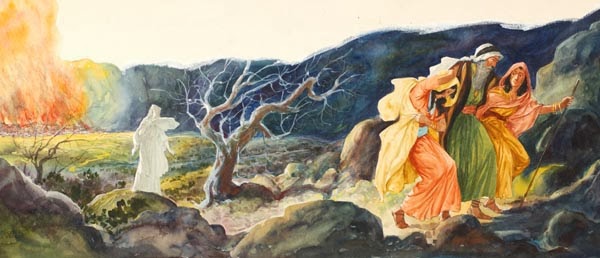
Lots wife turns into a pillar of salt when she sees the destruction of Sodom
When asked to substitute-teach a gospel doctrine lesson a few years ago, I discovered unexpected parallels between the Sodom and Gomorrah story and some of the stories preceding it. Upon further examination, I came to the realization that the story was probably not literal, but instead a construction based in part on two earlier stories. I’d like to touch on a few things that I believe call into question a literal interpretation of this story.
In two or three posts, I’ll discuss how these two stories fed into the Sodom and Gomorrah story.  I’ll also cover a later story that borrowed from and reshaped the story of Sodom and Gomorrah. Just a warning – all of the stories have to do with sex. Old Testament is very frank about sexuality and does not shy away from a discussing a wide variety of sexuality. As I’ve read through these stories, I’ve concluded that each author was determined to not to repeat any previously discussed form of sexuality, but instead add new twists based on the older stories. My intent was not been to explore sexuality, but instead the Sodom and Gomorrah story. However I’ve realized how integral sexuality was to the related stories.  All the stories tell of improbable, unproductive or inappropriate sexuality in order to demonstrate the superiority of Israel (or certain tribes of Israel) over its enemies.
- See more at: http://www.withoutend.org/sodom/#sthash.mbOz2ynJ.dpuf


--
You received this message because you are subscribed to the Google Groups "OldT" group.
To unsubscribe from this group and stop receiving emails from it, send an email to oldt+unsubscribe@googlegroups.com.
For more options, visit https://groups.google.com/groups/opt_out.

Thursday, February 6, 2014

[OT] Historical Torah

The Historical Torah

by
Daniel Thomas Andrew Daly
Copyright 6178 SC
http://noahidebooks.angelfire.com


Introduction

What is the 'Historical Torah'? Simply answered, it is that component of the written Torah, whatever that component may be, which is 100% genuinely historical in the detail it provides and the factuality and the truthfulness of the claims it makes.

Why the question? Simply put, this is a question from a soul (myself) and an organisation (The Historical Torah Society) who need greater understanding and clarity on this issue, ultimately, for the purposes of spiritual truth: for the gaining of wisdom and knowledge from that truth and for the application of any of God's divine principles of that truth which remain true at the end of our study. It is a real question to provide a real answer – what, in the Torah, are we supposed to observe.

What is the basis for this question? Simply put, the age old tradition of Moses as the author of the 5 books of the Written Torah was sufficiently debunked many years ago. The gradual development of the documentary hypothesis, which divides the authorship of the Torah into several strands, challenges the notion that all the Torah must be blindly obeyed and sworn allegiance to, simply because there are now reasonable questions as to the legitimacy of the information and how much is genuinely divinely inspired. Especially in the 19th Century, but particularly in the 20th, Biblical Criticism has developed to such a degree that the fundamentalist claims of an absolute literally divinely inspired Word of God in every detail have genuinely been shown to be false claims. What this implies for our purposes is that applying the legislation and principles of the Written Torah to ones life in every detail and attempting to teach that to others may 1) Not be necessary and 2) In fact be harmful for the often annoyance gained by those who dislike religion because of practices within that religion they find distasteful and reject.

Only the truth of God's faith can stand – if it is a system of knowledge defined by man which is shown, in time, to be corrupt, such a system must be ignored and replaced with the correct moral teachings. The Torah is so well entrenched in our society that many have taken for granted its acceptance regardless. But as we leave the 20th century, whose latter half saw a great increase in political correctness and biblical rejection, and we enter the 21st century, those of biblical faith are under greater attack than ever, and the bible more derided than any other time in its history.

The facts needed to be presented – clearly – not for the faith to 'Progress' but for the faith to be more firmly 'Established'. Only on the 'Truth' of scripture and the 'Truth' of divine revelation, can the faith hope to survive this century in any decent shape, and that of the generations to come.

Daniel Thomas Andrew Daly
Founder of the Historical Torah Society
Thursday 6th of February, 6178 SC
Macarthur, ACT, Australia


Chapter One
'Before we even Begin - Why the Torah is True Regardless'

"In the Beginning God Created Mankind. And then God created Reason. And with Reason mankind walked away from fables of snakes and floods and arks and commands, and realised nature was the answer, and that religion was a fowl invention of man."

While that fabulous quote is of my own invention, the rise of deism in America, belief in God without religion, is one the reasons our quest to find the genuine historical Torah is of importance. Deism does not so much deny the facts of scripture, as ridicule them as unworthy of any serious study simply because they appear to lack god given 'Reason'. The Miracles of scripture 'Defy Reason' and 'Logic' in the eyes of a deist, and God could in no way at all be the author of such confusion, which he obviously was, should he have authored such foolery.

Deism – belief in God without religion, based on one's own reason – is perhaps one of the greatest opportunities for evil there ever will be. For in the 'God of Nature alone' who will we be to one day ultimately judge what is 'Natural' and what is 'Unnatural'. For, as a Lion kills to eat, one day the deists might argue, as their morality crashes to even greater lows, that murder is a natural function of human society, and why on earth should we bother legislating against this fact? Simply let nature run its own course will be the accepted moral truth 'BASED ON REASON' that this movement will valiantly uphold.

Or they would.

If they ever got the power to do so.

They won't, though. The truth of El Shaddai will never allow such abominations.

You see, even the sinner kids next door, who see their dad boozing and hitting their mother can tell you murder is wrong, and even a sin. They see and know it every time he hits their mother. They see and know it every time he hits THEM. It is the cold hard fact of EVIL and in the end it is not the natural man which chooses this behaviour, but the man who has rejected knowledge of God and lawfulness, which has always been available from the creator, denies this very living God who rebukes him, and chooses to act, not in any form of reason of nature, but on the wicked choosings of the evil of his own heart and mind – HIS OWN CHOICES – and does evil.

And the conscience perpetually witnesses to this truth.

So, before we even really begin our study, in all my knowledge and revelation on life, I can already tell you this. You won't really throw out the Torah – or to be more accurate – the general message of the Torah, when all is said and done. Yahweh El Shaddai will triumph in the end, not even based on the Torah, for if you simply take it is as the writings of old Israel in a catalogue of a mishmash of historical legends, you can still understand, in the end, through reading its message, that whatever did go on historically in the end – whatever the truthfulness which IS in there about history – that the big guy presented within – GOD – really is the Creator God and that the morals he portrays, portrayed at a basic level, such as in the 10 commandments, really are true in the end anyway.

You don't need to know, ultimately, whether or not the bible is factual in every detail in the end, to not know in your heart, after an encounter with the text, that the creator of the universe is the one who is obviously being described in and that, whatever parts are legendary and whatever parts are true, they are still pointing to the creator of the universe and giving the essential message of the kinds of moral this creator emphasises and teaches for his human offspring.

Our own SELF-WILL and our own pigheadedness can interfere with this process. In our pride, which is the essential problem of deism and all false religions, we think we know better than God and can choose our own destiny. It is simply to choose freedom to do what we want, to have no superiors watching over us and lecturing us and, often, simply to bloody sin, that we are like this. We deny the God of lawfulness, because we don't want to be lawful. We want to do our own thing and have our own freedoms. We call the religious hypocrites because they don't justify all the lifestyle choices we want to make in our own lives. We say 'Live your own life' and 'Make your own choices' to justify this truth for our own belief in our own sovereign rights.

We all want to be our own God.

Yet, the morality which ultimately comes across from the Torah portrays a God who judges and makes rules, and this is the fundamental problem that deists and other objectors to the God of scripture and any moral truths being associated with scripture, have. They want their own freedoms and their own moral platitudes, often to play God themselves. Often to live the lifestyle choices they want to make, and there is nothing at all easier in simply finding a few biblical contradictions and off they go claiming the bible is all man-made and the religious are all hypocrites and you never have to worry about that old thing ever again.

And you know what?

That is probably the way God likes it.

Why? Because he is after the faithful and the servants. The moral and the truthful. Not ones who simply want to live as they please, and who will end up finding any old excuse anyway, regardless of how infallible or not the scriptures be, to justify their own choices.

And those choices usually end up being sin.

So, before we even begin, you will already find the Torah the truth, if you know the God of the Torah in your heart or have met him personally, and this study of ours will not convince you he isn't God, whatever the result. Yet, conversely, it may draw you a little closer, should you feel the bible is a pile of nothing more than vain traditions, when you understand a little more clearly how it came about and what portions are perhaps genuinely historical – or what ideas within those sources are genuinely historical in a divine sense as they claim – and in this understanding you might see a little more clearly the logic and truly rationale basis for believing in the God of scripture and why Jehovah has been part of mankind's history for so long now anyway.


Chapter Two
'The Canon is formed – the Tradition Begins'

The Council of Jamnia is a commonly held date for the timing of the canonisation of the Hebrew Tanakh. The idea of this council as an historical account was proposed by Heinrich Graetz in 1871. Before the destruction of the Second Temple in AD 70 with the sacking of Jerusalem by the invading Roman Armies, in Jamnia there had been a school of developed phariseeism, founded by Yohanan ben Zakkai. Yohanan had gained permission from the Roman Authorities to form a school of Halakah (Jewish Law) in Jamnia and the school was formed, as well as the Sanhedrin being relocated there. Later on at the end of the second century CE with the formation of the Mishnah (which Orthodoxy terms the 'Oral Law', believing it an orally passed on set of extra legal rulings originating in the time of Moses which, until being written down in the Mishnah, were only passed on Orally), the Mishnah records the discussion of the validity of certain texts of the Kethuvim as scripture. Graetz taught on these passages and other references, that the canonisation of the Tanakh as a whole, through primarily the Kethuvim being sanctioned as the third book of the Canon in the Jamnian period, supposedly took place in the period of AD 70 to AD 90 approximately.

In New Testament writings, the event chronicled as the 'Transfiguration' was supposedly Jesus justification before God upon the 'Law' and the 'Prophets'. Yet the Law and the Prophets are the 'Torah' and the 'Neviim'. NOT the writings, or the 'Kethuvim'.

Did the Kethuvim exist separately as its own book in the time of Jesus? Were the books of the Kethuvim part of the Prophets? For example, Jesus quotes the book of Daniel and claims Daniel as a prophet, yet the book of Daniel features only in the Kethvim in today's writings. Was Daniel part of the Neviim, though, in some traditions in the time of Jesus? Yet what of the Psalms? The New Testament quotes them constantly? Were they canon yet? Were they in the process of becoming canonised?

The information we have dates the origin of all the books of the Tanakh well before the time of Jesus of Nazareth, yet the New Testament writings shed no clear data on there being 3 parts of the Tanakh, nor do the early writings in the Mishnah show clearly their canonisation origin.

It is a matter of speculation, as more recent commentators since Graetz have objected to the Council of Jamnia being the time for the canonisation of the Tanakh as a whole. For example, Jack P Lewis wrote a critique, which was published in the April 1964 edition of 'Journal of Bible and Religion', in which he challenges what had become a consensus amongst many that Graetz hypothesis was practically proven.

According to Lewis:
The concept of the Council of Jamnia is an hypothesis to explain the canonisation of the Writings (the third division of the Hebrew Bible) resulting in the closing of the Hebrew canon. ... These ongoing debates suggest the paucity of evidence on which the hypothesis of the Council of Jamnia rests and raise the question whether it has not served its usefulness and should be relegated to the limbo of unestablished hypotheses. It should not be allowed to be considered a consensus established by mere repetition of assertion.
It is clear, though, that in the early centuries of the Common Era, a consensus of what the scriptures of the Tanakh WERE did become established so that by the time the Mishnah and the Babylonian and Palestinian Gemaras are complete (The Twin Talmud's from each of the schools rabbinic thought and discussions) the Hebrew Bible was officially canonised and accepted.

This was the view of Orthodoxy and Pharisaical Judaism. Karaite Judaism emerged later on in the first millennium CE under the initial impulses of Anan Ben David, which rejected the Talmudic literature as man-made, but did not disagree with the Talmudics on what constituted sacred scripture, the same 39 titled volumes of the Tanakh as we have them today, which are classified as 24 books.

The formation of the Tanakh seems to have progressed from first acceptance of the Torah, second, acceptance of the Torah and the Neviim, and third, acceptance of the Torah, Neviim and finally the Kethuvim also. It is hard to be completely precise with the data we have historically, for the canonisation or acceptance of various parts of the Hebrew Bible may have been done by this or that spiritual leader amongst the people and in Karaite tradition, the Sadducee's may or may not have accepted just the written Torah, meaning there was debate all along as to what was accepted as scripture and what was not. Thus to precisely date a time for the accepted canonisation of the official canon at an early date is not really available on current data, yet, we do know that by the time of the completion of the Talmud and with the origin of Karaism, the idea of the Tanakh as it stands today had been accepted as canon.

It was always accepted and believed that the Torah section of the Tanakh was written first, and that it dated back to Moses, the believed author. This is clearly the idea of the Pharisees and the Rabbis and the Karaite community upheld this also. To this day Orthodox Judaism, the inheritors of the Pharisaical rabbinic assemblies, and Karaite Judaism, uphold the general tradition of the written Torah originating in the time of Moses.

There are likely many opinions as to the final dating for the formation of the Torah, which is part of our job in this study, yet what we can know is this: When the canon ultimately did become formed, and by the time Karaite Judaism emerged, it was believed, and still is, that the written Torah was the work of the prophet Moses himself, that it represented the embodiment of the divine will of God, that it was flawless, without error, the perfect guide from God for man, and that it was, in all ways, the truth, and the answer to the meaning of life, and, in essence, the word of God.

Nothing less than that.


And this tradition lasted, and has lasted, and became law and became fact and became the book of the judgement of Israel and the book of the Judgement of the Kingdom of God.


And then a voice cried out.

And the cracks started to appear.


Chapter Three
'Rise of the Heretics – the First Biblical Critics'

The 17th century of the Christian era was an era which was highlighted by the continued dominance of the established Christian Church in Europe and the emerging new spiritual energy of the Protestant reformation. Yet equal to the zeal for biblical tradition, was an emerging zeal for biblical historical fact. Thus, while Martin Luther on the 31st of October 1517 sent his 'Disputation of Martin Luther on the Power and Efficacy of Indulgences' to Bishop Albert of Mainz, which came to be known as the 95 theses, probably only in legend nailed to the door of a catholic church, only 133 years later, Thomas Hobbes, in his work 'Leviathan', cited several passages of the holy writ of the Lawgiver Moses to demonstrate, in the pure historical simplicity of the scripture meaning what it says, that when Deuteronomy 34:6 teaches, of Moses, that 'No Man Knoweth of his Sepulchre to this Day' and Numbers 21:14 says 'Therefore it is said in the Book of the Wars of the Lord what he did in the Red Sea and in the brooks of Arnon' and Genesis 12:16 'And the Canaanite was then in the land', it becomes clear through observation of the historical context from which the subjects of each scripture are viewed from that it is a much latter date, well after the time of Moses.

The essential crux of Hobbes point is that Mosaic authorship of the entire Torah is obviously historically untrue. How could Moses write 'No man knoweth of his sepulchre to this day' in reference to his own grave, if he is still alive? And 'To this day' strongly suggests a fair passage of time has occurred. In a similar way 'It is said in the Book of the Wars of the Lord what he did in the Red Sea' appears to quite obviously be referring to a book known to the readers of the passage, about Moses, written at a latter time period. And, when it says 'And the Canaanite was then in the land' it becomes so obvious that it is set in a post conquest of Israel time period, after the sacking of the promised land under the warmanship of Joshua. The logical conclusion of Thomas Hobbes was that none of these passages were written by Moses.

Baruch Spinoza, born on the 24th of November 1632 and died on the 21st of February 1677, was a Dutch philosopher who has come to be considered by many as one of the great rationalists of 17th century philosophy. He was a figure instrumental in laying the groundwork for the Enlightenment of the 18th century, and for our purposes, one of the early leading voices in biblical criticism.

Baruch was a Jew. Yet he was also a critic, and he viewed the scriptures as true and factual and the word of Hashem or, what he gradually found out with his studies, fallible and, the religion he was living by, ignoring the plain facts of biblical and other passages to justify their tradition. In July 1656 the Talmud Torah congregation of Amsterdam issued a writ of excommunication against Baruch, which was not an uncommon practice of Jewry of the period. The essential claims of the Congregation were that Baruch was a heretic, taught abominations and committed monstrous deeds which had been clearly demonstrated. This translation of the official record of the censure illustrates the congregations concerns regarding the person of Baruch Spinoza.

The Lords of the ma'amad, having long known of the evil opinions and acts of Baruch de Espinoza, have endeavord by various means and promises, to turn him from his evil ways. But having failed to make him mend his wicked ways, and, on the contrary, daily receiving more and more serious information about the abominable heresies which he practiced and taught and about his monstrous deeds, and having for this numerous trustworthy witnesses who have deposed and born witness to this effect in the presence of the said Espinoza, they became convinced of the truth of the matter; and after all of this has been investigated in the presence of the honorable chachamin, they have decided, with their consent, that the said Espinoza should be excommunicated and expelled from the people of Israel. By the decree of the angels, and by the command of the holy men, we excommunicate, expel, curse and damn Baruch de Espinoza, with the consent of God, Blessed be He, and with the consent of all the Holy Congregation, in front of these holy Scrolls with the six-hundred-and-thirteen precepts which are written therein, with the excommunication with which Joshua banned Jericho, with the curse with which Elisha cursed the boys, and with all the curses which are written in the Book of the Law. Cursed be he by day and cursed be he by night; cursed be he when he lies down, and cursed be he when he rises up; cursed be he when he goes out, and cursed be he when he comes in. The Lord will not spare him; the anger and wrath of the Lord will rage against this man, and bring upon him all the curses which are written in this book, and the Lord will blot out his name from under heaven, and the Lord will separate him to his injury from all the tribes of Israel with all the curses of the covenant, which are written in the Book of the Law. But you who cleave unto the Lord God are all alive this day. We order that no one should communicate with him orally or in writing, or show him any favor, or stay with him under the same roof, or within four ells of him, or read anything composed or written by him.

The exact reasons for the issuance of the censure appear to be: he was teaching radical theological views, that the Amsterdam Jewish community was uncomfortable with such viewpoints which could affect their relationship with the Christian community of Amsterdam, and lack of contribution to the life of the Amsterdam community as he had already withdrawn himself and was no longer financially contributing. One would hope that a firm conviction on the authority of scripture were the main issues of concern for the community and that Baruch's outspoken views on the issue were the primary reason for the censure, yet I wonder how much the latter possibilities are closer to home.

Later, Spinoza addressed the congregation in an apology written in Spanish, to the elders of the Synagogue, were he quoted the medieval biblical commentator ibn Ezra regarding the passage Genesis 12:16, which ibn Ezra had called a 'mystery' and exhorted those who understand to keep it silent' amongst various other biblical passages, and made the claim, as had Hobbes, that Mosaic authorship of the written Torah as a whole was patently untrue.

He was excommunicated at 23, died at 44, yet his legacy remained an enduring one.

Others of the early 'Heretics' included Isaac de la Peyrere, Richard Simon and John Hampden, who came to similar conclusions, yet their works were condemned and several of them were imprisoned and forced to recant.

These were the biblical critics – the heretics – the forerunners of enlightenment, who knew the cry of today's politically correct that the bible was full of bongers, and that the religious hierarchy maintained their order through holy censure and holy writ, and that while you may 'Rage Against the Machine', in the end 'The bastards would have their way' because 'The majority would have its say'.

The biblical critics started the cracks.

But the faith remained, withstanding these early shots.

Big things started happening the following century as enlightenment dawned.

--
You received this message because you are subscribed to the Google Groups "OldT" group.
To unsubscribe from this group and stop receiving emails from it, send an email to oldt+unsubscribe@googlegroups.com.
For more options, visit https://groups.google.com/groups/opt_out.

[OT] The Historical Torah - First 3 Chapters

The Historical Torah

by
Daniel Thomas Andrew Daly
Copyright 6178 SC
http://noahidebooks.angelfire.com


Introduction

What is the 'Historical Torah'? Simply answered, it is that component of the written Torah, whatever that component may be, which is 100% genuinely historical in the detail it provides and the factuality and the truthfulness of the claims it makes.

Why the question? Simply put, this is a question from a soul (myself) and an organisation (The Historical Torah Society) who need greater understanding and clarity on this issue, ultimately, for the purposes of spiritual truth: for the gaining of wisdom and knowledge from that truth and for the application of any of God's divine principles of that truth which remain true at the end of our study. It is a real question to provide a real answer – what, in the Torah, are we supposed to observe.

What is the basis for this question? Simply put, the age old tradition of Moses as the author of the 5 books of the Written Torah was sufficiently debunked many years ago. The gradual development of the documentary hypothesis, which divides the authorship of the Torah into several strands, challenges the notion that all the Torah must be blindly obeyed and sworn allegiance to, simply because there are now reasonable questions as to the legitimacy of the information and how much is genuinely divinely inspired. Especially in the 19th Century, but particularly in the 20th, Biblical Criticism has developed to such a degree that the fundamentalist claims of an absolute literally divinely inspired Word of God in every detail have genuinely been shown to be false claims. What this implies for our purposes is that applying the legislation and principles of the Written Torah to ones life in every detail and attempting to teach that to others may 1) Not be necessary and 2) In fact be harmful for the often annoyance gained by those who dislike religion because of practices within that religion they find distasteful and reject.

Only the truth of God's faith can stand – if it is a system of knowledge defined by man which is shown, in time, to be corrupt, such a system must be ignored and replaced with the correct moral teachings. The Torah is so well entrenched in our society that many have taken for granted its acceptance regardless. But as we leave the 20th century, whose latter half saw a great increase in political correctness and biblical rejection, and we enter the 21st century, those of biblical faith are under greater attack than ever, and the bible more derided than any other time in its history.

The facts needed to be presented – clearly – not for the faith to 'Progress' but for the faith to be more firmly 'Established'. Only on the 'Truth' of scripture and the 'Truth' of divine revelation, can the faith hope to survive this century in any decent shape, and that of the generations to come.

Daniel Thomas Andrew Daly
Founder of the Historical Torah Society
Thursday 6th of February, 6178 SC
Macarthur, ACT, Australia


Chapter One
'Before we even Begin - Why the Torah is True Regardless'

"In the Beginning God Created Mankind. And then God created Reason. And with Reason mankind walked away from fables of snakes and floods and arks and commands, and realised nature was the answer, and that religion was a fowl invention of man."

While that fabulous quote is of my own invention, the rise of deism in America, belief in God without religion, is one the reasons our quest to find the genuine historical Torah is of importance. Deism does not so much deny the facts of scripture, as ridicule them as unworthy of any serious study simply because they appear to lack god given 'Reason'. The Miracles of scripture 'Defy Reason' and 'Logic' in the eyes of a deist, and God could in no way at all be the author of such confusion, which he obviously was, should he have authored such foolery.

Deism – belief in God without religion, based on one's own reason – is perhaps one of the greatest opportunities for evil there ever will be. For in the 'God of Nature alone' who will we be to one day ultimately judge what is 'Natural' and what is 'Unnatural'. For, as a Lion kills to eat, one day the deists might argue, as their morality crashes to even greater lows, that murder is a natural function of human society, and why on earth should we bother legislating against this fact? Simply let nature run its own course will be the accepted moral truth 'BASED ON REASON' that this movement will valiantly uphold.

Or they would.

If they ever got the power to do so.

They won't, though. The truth of El Shaddai will never allow such abominations.

You see, even the sinner kids next door, who see their dad boozing and hitting their mother can tell you murder is wrong, and even a sin. They see and know it every time he hits their mother. They see and know it every time he hits THEM. It is the cold hard fact of EVIL and in the end it is not the natural man which chooses this behaviour, but the man who has rejected knowledge of God and lawfulness, which has always been available from the creator, denies this very living God who rebukes him, and chooses to act, not in any form of reason of nature, but on the wicked choosings of the evil of his own heart and mind – HIS OWN CHOICES – and does evil.

And the conscience perpetually witnesses to this truth.

So, before we even really begin our study, in all my knowledge and revelation on life, I can already tell you this. You won't really throw out the Torah – or to be more accurate – the general message of the Torah, when all is said and done. Yahweh El Shaddai will triumph in the end, not even based on the Torah, for if you simply take it is as the writings of old Israel in a catalogue of a mishmash of historical legends, you can still understand, in the end, through reading its message, that whatever did go on historically in the end – whatever the truthfulness which IS in there about history – that the big guy presented within – GOD – really is the Creator God and that the morals he portrays, portrayed at a basic level, such as in the 10 commandments, really are true in the end anyway.

You don't need to know, ultimately, whether or not the bible is factual in every detail in the end, to not know in your heart, after an encounter with the text, that the creator of the universe is the one who is obviously being described in and that, whatever parts are legendary and whatever parts are true, they are still pointing to the creator of the universe and giving the essential message of the kinds of moral this creator emphasises and teaches for his human offspring.

Our own SELF-WILL and our own pigheadedness can interfere with this process. In our pride, which is the essential problem of deism and all false religions, we think we know better than God and can choose our own destiny. It is simply to choose freedom to do what we want, to have no superiors watching over us and lecturing us and, often, simply to bloody sin, that we are like this. We deny the God of lawfulness, because we don't want to be lawful. We want to do our own thing and have our own freedoms. We call the religious hypocrites because they don't justify all the lifestyle choices we want to make in our own lives. We say 'Live your own life' and 'Make your own choices' to justify this truth for our own belief in our own sovereign rights.

We all want to be our own God.

Yet, the morality which ultimately comes across from the Torah portrays a God who judges and makes rules, and this is the fundamental problem that deists and other objectors to the God of scripture and any moral truths being associated with scripture, have. They want their own freedoms and their own moral platitudes, often to play God themselves. Often to live the lifestyle choices they want to make, and there is nothing at all easier in simply finding a few biblical contradictions and off they go claiming the bible is all man-made and the religious are all hypocrites and you never have to worry about that old thing ever again.

And you know what?

That is probably the way God likes it.

Why? Because he is after the faithful and the servants. The moral and the truthful. Not ones who simply want to live as they please, and who will end up finding any old excuse anyway, regardless of how infallible or not the scriptures be, to justify their own choices.

And those choices usually end up being sin.

So, before we even begin, you will already find the Torah the truth, if you know the God of the Torah in your heart or have met him personally, and this study of ours will not convince you he isn't God, whatever the result. Yet, conversely, it may draw you a little closer, should you feel the bible is a pile of nothing more than vain traditions, when you understand a little more clearly how it came about and what portions are perhaps genuinely historical – or what ideas within those sources are genuinely historical in a divine sense as they claim – and in this understanding you might see a little more clearly the logic and truly rationale basis for believing in the God of scripture and why Jehovah has been part of mankind's history for so long now anyway.


Chapter Two
'The Canon is formed – the Tradition Begins'

The Council of Jamnia is a commonly held date for the timing of the canonisation of the Hebrew Tanakh. The idea of this council as an historical account was proposed by Heinrich Graetz in 1871. Before the destruction of the Second Temple in AD 70 with the sacking of Jerusalem by the invading Roman Armies, in Jamnia there had been a school of developed phariseeism, founded by Yohanan ben Zakkai. Yohanan had gained permission from the Roman Authorities to form a school of Halakah (Jewish Law) in Jamnia and the school was formed, as well as the Sanhedrin being relocated there. Later on at the end of the second century CE with the formation of the Mishnah (which Orthodoxy terms the 'Oral Law', believing it an orally passed on set of extra legal rulings originating in the time of Moses which, until being written down in the Mishnah, were only passed on Orally), the Mishnah records the discussion of the validity of certain texts of the Kethuvim as scripture. Graetz taught on these passages and other references, that the canonisation of the Tanakh as a whole, through primarily the Kethuvim being sanctioned as the third book of the Canon in the Jamnian period, supposedly took place in the period of AD 70 to AD 90 approximately.

In New Testament writings, the event chronicled as the 'Transfiguration' was supposedly Jesus justification before God upon the 'Law' and the 'Prophets'. Yet the Law and the Prophets are the 'Torah' and the 'Neviim'. NOT the writings, or the 'Kethuvim'.

Did the Kethuvim exist separately as its own book in the time of Jesus? Were the books of the Kethuvim part of the Prophets? For example, Jesus quotes the book of Daniel and claims Daniel as a prophet, yet the book of Daniel features only in the Kethvim in today's writings. Was Daniel part of the Neviim, though, in some traditions in the time of Jesus? Yet what of the Psalms? The New Testament quotes them constantly? Were they canon yet? Were they in the process of becoming canonised?

The information we have dates the origin of all the books of the Tanakh well before the time of Jesus of Nazareth, yet the New Testament writings shed no clear data on there being 3 parts of the Tanakh, nor do the early writings in the Mishnah show clearly their canonisation origin.

It is a matter of speculation, as more recent commentators since Graetz have objected to the Council of Jamnia being the time for the canonisation of the Tanakh as a whole. For example, Jack P Lewis wrote a critique, which was published in the April 1964 edition of 'Journal of Bible and Religion', in which he challenges what had become a consensus amongst many that Graetz hypothesis was practically proven.

According to Lewis:
The concept of the Council of Jamnia is an hypothesis to explain the canonisation of the Writings (the third division of the Hebrew Bible) resulting in the closing of the Hebrew canon. ... These ongoing debates suggest the paucity of evidence on which the hypothesis of the Council of Jamnia rests and raise the question whether it has not served its usefulness and should be relegated to the limbo of unestablished hypotheses. It should not be allowed to be considered a consensus established by mere repetition of assertion.
It is clear, though, that in the early centuries of the Common Era, a consensus of what the scriptures of the Tanakh WERE did become established so that by the time the Mishnah and the Babylonian and Palestinian Gemaras are complete (The Twin Talmud's from each of the schools rabbinic thought and discussions) the Hebrew Bible was officially canonised and accepted.

This was the view of Orthodoxy and Pharisaical Judaism. Karaite Judaism emerged later on in the first millennium CE under the initial impulses of Anan Ben David, which rejected the Talmudic literature as man-made, but did not disagree with the Talmudics on what constituted sacred scripture, the same 39 titled volumes of the Tanakh as we have them today, which are classified as 24 books.

The formation of the Tanakh seems to have progressed from first acceptance of the Torah, second, acceptance of the Torah and the Neviim, and third, acceptance of the Torah, Neviim and finally the Kethuvim also. It is hard to be completely precise with the data we have historically, for the canonisation or acceptance of various parts of the Hebrew Bible may have been done by this or that spiritual leader amongst the people and in Karaite tradition, the Sadducee's may or may not have accepted just the written Torah, meaning there was debate all along as to what was accepted as scripture and what was not. Thus to precisely date a time for the accepted canonisation of the official canon at an early date is not really available on current data, yet, we do know that by the time of the completion of the Talmud and with the origin of Karaism, the idea of the Tanakh as it stands today had been accepted as canon.

It was always accepted and believed that the Torah section of the Tanakh was written first, and that it dated back to Moses, the believed author. This is clearly the idea of the Pharisees and the Rabbis and the Karaite community upheld this also. To this day Orthodox Judaism, the inheritors of the Pharisaical rabbinic assemblies, and Karaite Judaism, uphold the general tradition of the written Torah originating in the time of Moses.

There are likely many opinions as to the final dating for the formation of the Torah, which is part of our job in this study, yet what we can know is this: When the canon ultimately did become formed, and by the time Karaite Judaism emerged, it was believed, and still is, that the written Torah was the work of the prophet Moses himself, that it represented the embodiment of the divine will of God, that it was flawless, without error, the perfect guide from God for man, and that it was, in all ways, the truth, and the answer to the meaning of life, and, in essence, the word of God.

Nothing less than that.


And this tradition lasted, and has lasted, and became law and became fact and became the book of the judgement of Israel and the book of the Judgement of the Kingdom of God.


And then a voice cried out.

And the cracks started to appear.


Chapter Three
'Rise of the Heretics – the First Biblical Critics'

The 17th century of the Christian era was an era which was highlighted by the continued dominance of the established Christian Church in Europe and the emerging new spiritual energy of the Protestant reformation. Yet equal to the zeal for biblical tradition, was an emerging zeal for biblical historical fact. Thus, while Martin Luther on the 31st of October 1517 sent his 'Disputation of Martin Luther on the Power and Efficacy of Indulgences' to Bishop Albert of Mainz, which came to be known as the 95 theses, probably only in legend nailed to the door of a catholic church, only 133 years later, Thomas Hobbes, in his work 'Leviathan', cited several passages of the holy writ of the Lawgiver Moses to demonstrate, in the pure historical simplicity of the scripture meaning what it says, that when Deuteronomy 34:6 teaches, of Moses, that 'No Man Knoweth of his Sepulchre to this Day' and Numbers 21:14 says 'Therefore it is said in the Book of the Wars of the Lord what he did in the Red Sea and in the brooks of Arnon' and Genesis 12:16 'And the Canaanite was then in the land', it becomes clear through observation of the historical context from which the subjects of each scripture are viewed from that it is a much latter date, well after the time of Moses.

The essential crux of Hobbes point is that Mosaic authorship of the entire Torah is obviously historically untrue. How could Moses write 'No man knoweth of his sepulchre to this day' in reference to his own grave, if he is still alive? And 'To this day' strongly suggests a fair passage of time has occurred. In a similar way 'It is said in the Book of the Wars of the Lord what he did in the Red Sea' appears to quite obviously be referring to a book known to the readers of the passage, about Moses, written at a latter time period. And, when it says 'And the Canaanite was then in the land' it becomes so obvious that it is set in a post conquest of Israel time period, after the sacking of the promised land under the warmanship of Joshua. The logical conclusion of Thomas Hobbes was that none of these passages were written by Moses.

Baruch Spinoza, born on the 24th of November 1632 and died on the 21st of February 1677, was a Dutch philosopher who has come to be considered by many as one of the great rationalists of 17th century philosophy. He was a figure instrumental in laying the groundwork for the Enlightenment of the 18th century, and for our purposes, one of the early leading voices in biblical criticism.

Baruch was a Jew. Yet he was also a critic, and he viewed the scriptures as true and factual and the word of Hashem or, what he gradually found out with his studies, fallible and, the religion he was living by, ignoring the plain facts of biblical and other passages to justify their tradition. In July 1656 the Talmud Torah congregation of Amsterdam issued a writ of excommunication against Baruch, which was not an uncommon practice of Jewry of the period. The essential claims of the Congregation were that Baruch was a heretic, taught abominations and committed monstrous deeds which had been clearly demonstrated. This translation of the official record of the censure illustrates the congregations concerns regarding the person of Baruch Spinoza.

The Lords of the ma'amad, having long known of the evil opinions and acts of Baruch de Espinoza, have endeavord by various means and promises, to turn him from his evil ways. But having failed to make him mend his wicked ways, and, on the contrary, daily receiving more and more serious information about the abominable heresies which he practiced and taught and about his monstrous deeds, and having for this numerous trustworthy witnesses who have deposed and born witness to this effect in the presence of the said Espinoza, they became convinced of the truth of the matter; and after all of this has been investigated in the presence of the honorable chachamin, they have decided, with their consent, that the said Espinoza should be excommunicated and expelled from the people of Israel. By the decree of the angels, and by the command of the holy men, we excommunicate, expel, curse and damn Baruch de Espinoza, with the consent of God, Blessed be He, and with the consent of all the Holy Congregation, in front of these holy Scrolls with the six-hundred-and-thirteen precepts which are written therein, with the excommunication with which Joshua banned Jericho, with the curse with which Elisha cursed the boys, and with all the curses which are written in the Book of the Law. Cursed be he by day and cursed be he by night; cursed be he when he lies down, and cursed be he when he rises up; cursed be he when he goes out, and cursed be he when he comes in. The Lord will not spare him; the anger and wrath of the Lord will rage against this man, and bring upon him all the curses which are written in this book, and the Lord will blot out his name from under heaven, and the Lord will separate him to his injury from all the tribes of Israel with all the curses of the covenant, which are written in the Book of the Law. But you who cleave unto the Lord God are all alive this day. We order that no one should communicate with him orally or in writing, or show him any favor, or stay with him under the same roof, or within four ells of him, or read anything composed or written by him.

The exact reasons for the issuance of the censure appear to be: he was teaching radical theological views, that the Amsterdam Jewish community was uncomfortable with such viewpoints which could affect their relationship with the Christian community of Amsterdam, and lack of contribution to the life of the Amsterdam community as he had already withdrawn himself and was no longer financially contributing. One would hope that a firm conviction on the authority of scripture were the main issues of concern for the community and that Baruch's outspoken views on the issue were the primary reason for the censure, yet I wonder how much the latter possibilities are closer to home.

Later, Spinoza addressed the congregation in an apology written in Spanish, to the elders of the Synagogue, were he quoted the medieval biblical commentator ibn Ezra regarding the passage Genesis 12:16, which ibn Ezra had called a 'mystery' and exhorted those who understand to keep it silent' amongst various other biblical passages, and made the claim, as had Hobbes, that Mosaic authorship of the written Torah as a whole was patently untrue.

He was excommunicated at 23, died at 44, yet his legacy remained an enduring one.

Others of the early 'Heretics' included Isaac de la Peyrere, Richard Simon and John Hampden, who came to similar conclusions, yet their works were condemned and several of them were imprisoned and forced to recant.

These were the biblical critics – the heretics – the forerunners of enlightenment, who knew the cry of today's politically correct that the bible was full of bongers, and that the religious hierarchy maintained their order through holy censure and holy writ, and that while you may 'Rage Against the Machine', in the end 'The bastards would have their way' because 'The majority would have its say'.

The biblical critics started the cracks.

But the faith remained, withstanding these early shots.

Big things started happening the following century as enlightenment dawned.

--
You received this message because you are subscribed to the Google Groups "OldT" group.
To unsubscribe from this group and stop receiving emails from it, send an email to oldt+unsubscribe@googlegroups.com.
For more options, visit https://groups.google.com/groups/opt_out.
Friday, December 20, 2013

[OT] Fwd: Discovering the Old Testament podcast


Discovering the Old Testament

By Sheldon Greaves

Podcast:
http://www.lafkospress.com/discovering-the-old-testament-2/

A series of brief lectures about the history, culture, archaeology, and languages behind the Old Testament (Hebrew Scriptures) based on a series of seminars and a summer course taught at Stanford University in 2013. We examine the Old Testament in the context of its mysterious and exotic world and times. An ongoing educational tool for personal study, adult education groups, sermon preparation, or personal enrichment.

Sheldon Greaves received his Ph.D. in ancient Near Eastern Studies from the University of California at Berkeley in 1996, with his main area of emphasis on the Hebrew Bible. His other areas of emphasis were Canaanite Religion and Religion and Magic in Ancient Mesopotamia. He has published articles on wordplay in Ugaritic magical texts and Babylonian omens, as well as the book of Genesis.


--
You received this message because you are subscribed to the Google Groups "OldT" group.
To unsubscribe from this group and stop receiving emails from it, send an email to oldt+unsubscribe@googlegroups.com.
For more options, visit https://groups.google.com/groups/opt_out.

Thursday, February 28, 2013

[OT] Basics of Ancient Ugaritic: A Concise Grammar, Workbook, and Lexicon

Review
=====

Title: Basics of Ancient Ugaritic: A Concise Grammar, Workbook, and Lexicon 
Author: Michael Williams
Publisher: Zondervan
Genre: Ancient Languages, Biblical Studies
Year Published: 2012
Number of Pages: 143
Binding: Paperback
ISBN10: 031049592X

ISBN13: 978-0310495925 
Price: $49.99

Reviewed by Bryan Buchanan for the Association for Mormon Letters 

 
There are "mostly dead" languages (think Latin) and then "all dead" languages that literally had to be unearthed.  Ugaritic is a prime example of the latter. Named for the ancient city of Ugarit (known in modern times as Ras Shamra) along the Mediterranean coast of present-day Syria, Ugaritic is a language from the same Northwest Semitic family as Hebrew and Aramaic.  The alphabet is--oddly enough--a cuneiform system of 30 letters (no vowels, much like Hebrew).  The language, once transliterated away from the unfamiliar symbols, suddenly becomes a very familiar-looking language for someone who knows even basic biblical Hebrew.
 
A completely accidental discovery of a tomb and subsequent excavations in and around Ras Shamra turned up more than 1500 texts.  The bulk of these deal with epic texts such as the "Legend of Aqhat," "The Legend of King Kirta/Keret" and the Ba'al and Anat cycles.  The last of these, Ba'al and Anat, are likely of the greatest interest given their relationship to deities and accounts found in the Hebrew Bible.  Williams notes that El roughly corresponds to Elohim (God the Father in Mormon terms) while Ba'al (the son of El) can be seen in Mormon context as Jehovah/Jesus Christ.  Interestingly, each of these deities has a consort: Athirat/Asherah connected with El and Anat with Ba'al.  Finally, Mot—as a deity not worshipped as he is an enemy to Ba'al—can be seen as a Satan-like figure.  All of these deities appear in the Hebrew Bible, though often in vague or muddied allusions.
 
The way in which Ugaritic texts interface with the narratives of the Hebrew Bible is fascinating.  For example, there is a puzzle of how Daniel could appear in Ezekiel 14 and 28 since he is mentioned as someone familiar to everyone but would come toward the end of Ezekiel's era.  As the king in the legend of Aqhat text is named "Dan'el" perhaps the gymnastics weren't necessary in the first place.  Another instance that I found intriguing is the *rapa'uma* of the Ugaritic texts—the Hebrew Bible mentions *repha'im* but their nature is unclear.  Williams notes that these figures are "inhabitants of the underworld and may be deified royal ancestors."  Isa 14:9 notes that these *repha'im* meet those that come to *sheol* (identified as "a world of spirits" in Joseph Smith's thought).  With the combination of family history and theosis in their theology, Mormons will undoubtedly find this connection of interest.
 
Following a chapter on the relationship of Ugaritic and Hebrew generally [1] and one on the alphabet, Williams discusses the nouns.  Like other Semitic languages, Ugaritic uses a triliteral root system where (usually) three consonants constitute the core of the noun. Williams discusses five aspects of a noun: case, gender, definiteness, number and state.  As per his standard, the details are kept to a minimum and many times he simply says "we'll talk about this later."  A paradigm chart and a few exercises finish off this chapter.
 
As he introduces the different types of adjectives, Williams must deal with increasing amounts of terminology: substantive, predicative, comparative, participles, etc.  He does so concisely, often giving a similar example in English to make the concept clear.  This chapter is even more brief than the previous section on nouns—only four pages in this case. [2]  The chapter on prepositions is similarly short and to the point—for someone with background in biblical Hebrew, these are all familiar and function in much the same way.  The pronouns (both independent and suffixes) are again very much analogous to their Hebrew counterparts.  There are, however, relative and demonstrative pronouns that will be new territory.
 
To initiate the section on verbs, Williams helpfully alerts the reader that one has to step outside of Western-style grammar and forget traditional "tenses."  Ugaritic seems to be even more fluid in this regard than Hebrew and much depends on context.  As he does in other places in the text, Williams reminds the reader that scholarly judgment is still out on many aspects of Ugaritic and the verbal structures are perhaps the best example of this.  He introduces the two main "conjugations" and paradigms charts but does not go into any more detail.  The next chapter discusses "moods" such as indicative, energic (meaning something like "really" doing something—I have never encountered this idea in other languages and found it interesting), jussive and imperative.
 
A very short treatment of infinitives and their functions then leads into the thematic stems (equivalent to the *binyanim* of Hebrew).  I found this section very entertaining—as verbs are the heart of any language, it is intriguing to see how they function (especially in a language essentially frozen in time several thousand years ago!).  The basic form is known as the G stem and everything branches out from there.  The different stems can indicate reflexive, passive and causative effects.  Then, since any language outside of Esperanto wouldn't be any fun without some odd verbs, Williams discusses "weak" verbs that do not include all "strong" consonants. Again, with some Hebrew in your toolbox, this idea is very normal but will take some getting used to otherwise.
 
The final chapter serves as the junk drawer where Williams can place linguistic items that don't really fit anywhere else.  I particularly enjoyed the "Attention Grabbers" that express ideas like "look!", "behold!", and "woe!"  Given the relationship of Ugaritic to the Hebrew Bible, these terms feel very familiar.  Several appendices provide a comparative alphabet chart, designations for the several major collections of Ugaritic texts, an extensive vocabulary list, bibliography and answers to the exercises.
 
In assessing "Basics of Ancient Ugaritic," audience might be the key term.  As part of the "Basics" lineup from a publisher not devoted solely or even primarily to academic output, its level of detail seems appropriate.  That said, compared to the other titles in the series (Hebrew, Greek, Aramaic, etc.), it came off to me as overly simplistic.  For example, having reviewed the recent title on Aramaic, I wasn't quite satisfied with how this turned out. 
 
One case in point—in the introduction ("Taking the 'Ugh' Out of Ugaritic") the author notes he intends to include humor and create a few laughs.  "Informality" seems to be a more accurate term.  Phrases such as "don't let X alarm you" and "that wasn't so bad" struck me not as humorous but simply a conscious effort to avoid the jargony flavor of most grammars (which is a fine goal). 
 
However, I think there is an essential difference between this particular "Basics" title and, say, the Hebrew or Greek ones.  Where you undoubtedly will have many people picking up the latter simply because they are biblical languages and they have some passing curiosity, that is much less likely to be the case with Ugaritic.   Those who purchase this book have, by that very action, demonstrated that they are of a more serious bent.  Therefore, treating this book in a more informal manner than even the Hebrew or Greek seems to me not to be the best approach.  However, in saying this, my intent is not to leave one with the impression that this book is a failure.  Williams has taken a language that most people have never heard of (I got some great reactions telling people I was reviewing this book) and produced a very usable one-volume introduction to Ugaritic, a language important on its own terms and doubly so due to its intimate connection to Hebrew and the Hebrew Bible.
  
 
[1] I found it odd that he did not address the parallel development of morphology in Ugaritic and Hebrew (I can't imagine many people coming to Ugaritic cold)—for example, once one knows that the "t" in Ugaritic can correspond to "sh" in Hebrew, the "tlt" in Ugaritic is easily seen as the cognate of "shalosh" ("three") in Hebrew.
 
[2] The book checks in under 150 pages (more like 100 without the appendices) and, yet retails at $49.99.  While, compared to many textbooks, this is certainly not unheard of.  It appears to be a print-on-demand title, making the price seem a bit steep.

--
You received this message because you are subscribed to the Google Groups "OldT" group.
To unsubscribe from this group and stop receiving emails from it, send an email to oldt+unsubscribe@googlegroups.com.
For more options, visit https://groups.google.com/groups/opt_out.


Thursday, October 13, 2011

[OT] Review: Scripture and the Authority of God: How to Read the Bible Today


q?_encoding=UTF8&Format=_SL110_&ASIN=0062011952&MarketPlace=US&ID=AsinImage&WS=1&tag=mormonchronic-20&ServiceVersion=20070822"...Writing a book about the Bible is like building a sandcastle in front of the Matterhorn.  The best you can hope to do is to catch the eye of those who are looking down instead of up, or those who are so familiar with the skyline that they have stopped noticing its peculiar beauty...."

Review
======

Title: Scripture and the Authority of God: How to Read the Bible Today
Author: N. T. Wright
Publisher: HarperOne
Genre: Bible
Year: 2011
Pages: 224
Binding: Hardcover
ISBN13: 9780062011954
Price: $25.99

Reviewed by Blair Dee Hodges for the Association for Mormon Letters

N.T.  Wright has been called the C.S.  Lewis for our time.  Like Lewis, Wright is Anglican.  Like Lewis, Wrights overriding purpose is to demonstrate Christianitys relevance for our times (Lewis with modernism, Wright with postmodernism).  Lewis wrote "Surprised by Joy," Wright wrote "Surprised by Hope." Like Lewis, Wrights style is cleverly engaging.  This particular similarity is evident from the first line of Wrights latest publication:

Writing a book about the Bible is like building a sandcastle in front of the Matterhorn.  The best you can hope to do is to catch the eye of those who are looking down instead of up, or those who are so familiar with the skyline that they have stopped noticing its peculiar beauty (ix).

Odds are, if youve enjoyed Lewiss theological or devotional writings, youll enjoy Wrights.  Some differences between the two deserve attention.  Unlike Lewis, who was content to remain a lay Anglican, Wright is Bishop of Durham and sits in the UKs House of Lords.  Unlike Lewis, who was an armchair theologian and literary critic whose fiction largely outranks his non-fiction, Wright is a distinguished Bible scholar who takes higher criticism much more seriously than Lewis could have.  Lewis still serves as a sort of safe source for many Mormons who are pleased to find similar theological ground in the works of a non-LDS author.  Wright can easily serve a similar purpose for Mormons in regards to contemporary biblical scholarship.[1] He has a knack for making complex academic discussions comprehensible to regular folk like me.  It is with this in mind that I recommend his latest book, "Scripture and the Athority of God."[2] Its a lot thicker than its 224 pages appear at first g
 lance as evinced by this over-long, chapter-by-chapter review, but at least the prose is almost always accessible and the analogies creative!

Taken as a whole, Wright writes, Christendom cant live without the Bible, but it doesnt seem to have much idea of how to live with it (ix).  With no pretense at completeness, Wrights Prologue gives an overview of the place of Old Testament scripture within the Christian church beginning with the time of Jesus.[3] He contextualizes the writing of the New Testament and outlines the growth of tradition and authority in biblical use up to the Reformation when individual scripture reading accelerated.  Reason comes to the fore during Enlightenment debates over scripture, debates which echo today.  These periods receive closer attention in subsequent chapters.  His prologue concludes with a look at how contemporary culture views scripture in tandem with politics, philosophy, theology and ethics.  He sees Bible believers and disbelievers making selective, shallow use of the Bible.  So-called conservatives privilege a literal reading of Paul while ignoring his ecclesial, ecumenical,  sacramental, and ecological dimensions.  So-called radicals, in a gallery stacked with iconoclasts enjoy saying things like Paul says this, and we now know hes wrong (19).  These, and other approaches, receive Wrights scorn throughout the book.

In the first chapter Wright displaces the Bible as the primary authority by, oddly enough, quoting the Bible as identifying God as its source of authority.[4] The book doesnt argue *that* the Bible should have authority; its approaching the question of *how* a book can have authority and what shape that authority can take (16).  God, not the Bible, is the authority, and scripture has authority only in a delegated or mediated sense (23).  Further, the Bibles over-arching content is narrative; it tells a story.  Rather than being a rule-book from which we pick and choose things to do, the Bible tells a story within which the reader is also situated.  Scripture is there to be a means of Gods action in and through uswhich will include, but go far beyond, the mere conveying of information (28).  Mormons will be comfortable with Wrights description of a much older notion of revelation, according to which God is continually revealing himself to and within the world he has made, and   particularly to and within his people Israel (29).[5] This is a key interpretive principle Wright will return to throughout his book.

Chapter Two serves to describe scripture as a record of Gods response to evil and suffering in the world through a selected people, Israel.  The records tell the story of God and his people, places obligations upon them, and gives voice to prophets who try to call a straying Israel to repentance.  God was equipping his people to serve his purposes, the establishment of a Kingdom (35).  Scripture told Israel that God was with them and that he wanted things to get better.  It formed the controlling *story* for Israel, and it formed the call to a present *obedience* (38-39, emphasis in original).

Chapter Three brings Jesus into the picture.  By analyzing the sayings and actions of Jesus in comparison with the Old Testament, Wright argues that at the heart of [Jesus's] work lay the sense of bringing the story of scripture to its climax, and thereby offering to God the *obedience* through which the Kingdom would be accomplished (41, emphasis in orig.).  Thus, sifting through the Old Testament for prophecies about individual acts of Jesus largely misses the point.  As the word made flesh, Jesus viewed himself as enacting and fulfilling scripture, although this raised some interesting contradictions.  Wright identifies the conundrum pressing heavily upon early Christian believers: finding ways to account for continuity and discontinuity with the Old Testament.

This is the bridge to Chapter Four, which analyzes the early apostolic churchs approach to scripture.  When Christians today refer to the word, they usually mean the Bible itself.  The word, Wright argues, clearly preceded the creation of our current canon, though.  Early Christians understood the word to be the story of Jesus, the enacting of the promises of Hebrew scripture with ongoing obligations and expectations for the new covenant movement (48).  Here Wright has set the stage for his fully Christian theology of scriptural authority:

Planted firmly in the soil of the missionary community, confronting the powers of the world with the news of the Kingdom of God, refreshed and invigorated by the Spirit, growing particularly through the preaching and teaching of the apostles, and bearing fruit in the transformation of human lives as the start of Gods project to put the whole creation to rights (50).

Wright argues that inattention to this narrative-driven nature of scripture results in the sterile debate between people who say, The Bible says and those who answer, Yes, and the Bible also says you should stone adulterers, and you shouldnt wear clothes made of two types of cloth.  We earnestly need to get past this unnecessary roadblock and on to more serious engagement (122).

Chapter Five is eminently interesting, as Wright looks at The First Sixteen Centuries.  Mormons might be disposed to disregard this chapter on the grounds of the Great Apostasy, but Wright doesnt follow the LDS narrative.  Mormons can learn much from careful and charitable examinations of this period especially because the goings-on still affect how people, including Mormons, read the Bible today.

He describes Four Senses of interpretation (69): 1.  The literal, or how the writers understood what they were recording (a complex method because not all scripture was intended to be taken scientifically, historically, etc.  and the Bible contains parables, metaphors, etc.) 2.  The allegorical, whereby Christians discovered (or rather, imputed) Christian elements in non-Christian verses.  (Abrahams sacrifice of Isaac representing Gods sacrifice of Jesus, for instance.) 3.  The analogical sense, which Wright describes as a way of discovering in the text a picture of the future life (69).  A Psalm speaking of going up to Jerusalem became a way to imagine going up to the heavenly city.  4.  The moral sense, a way of discovering lessons on how to behave hidden within texts which were not straightforwardly teaching such a thing (69).

Wrights at his best here.  He recognizes the utility of these approaches: wherever one opened the Bible one might discover not only what happened in the past, but an open door upon the riches of Christian truth, the glory that lay ahead, and the solid ground of Christian morality (70).  At the same time, he calls attention to the heavy cost: now almost anything could be proved from scripture (70-71).  The tale could easily wag the dog:

It is no longer authoritative in any strict sense; that is, it may be cited as though in proof of some point or other, but it is not leading the way, energizing the church with the fresh breath of God himself.  The question must be asked, whether scripture is being used to serve an existing theology or vice versa (71, see also 67).

In the next chapter on the Enlightenment, Wright brings the narrative to the present in order to make a stirring case against anti-intellectualism, but also against the deification of intellectualism.  Today, he argues, we ought to be aware what Enlightenment assertions must be politely denied, which of its challenges may be taken up and by what means, and which of its accomplishments must be welcomed and enhanced (84).

Speaking of politely denying, the gloves come off in Chapter Seven where Wright identifies a short list of Misreadings of Scripture (107).  He acknowledges the over-simplification here, but at the risk of caricature he dismisses things like the rapture, prosperity gospel, the death penalty, and attacks the tacit acceptance of the economic status quo (108).  He also challenges claims to objectivity, cultural relativity, grab-bag exegesis, skin-deep-only appeals to contextual readings and a host of other hot-button issues (109-111).

While acknowledging the murkiness of the past, Wright holds that we do, in some sense, have serious and academic methods by which we can say definitely that some readings of ancient texts are historically preferable to others (113).  In chapter eight, How to Get Back on Track, Wright proposes a five-part recommendation for approaching scripture today.  As a reminder, up to this point Wright has made a case that the authority of scripture, when unpacked, offers a picture of Gods sovereign and saving plan for the entire cosmos, dramatically inaugurated by Jesus himself, now to be implemented through the Spirit-led life of the church *precisely as the scripture-reading community* (115-116, emphasis in orig.) Thus, reading scripture today requires respect for tradition.  They may be wrong sometimes, he adds, but every key figure in the history of the church has left his, her, or its mark on subsequent readings of scripture (118).  It requires respect for reason.  This includes be
 ing self-aware of ones interpretive context in the wider scheme of things.  It also requires giving attention to, and celebrating, the many and massive discoveries in biology, archaeology, physics, astronomy, and so on, which shed great light on Gods world and the human condition (120).  His five-step model highlights the necessity for both public and private study, academic and devotional approaches.[6]

An interesting underlying tension throughout Wrights book (and his work more broadly) is that a solid pathway needs to be carved between academic research and devotional application of scripture.  In the final two chapters Wright presents models of how his desired approach can refresh scriptural interpretation in regards to the Sabbath and monogamy.  One might quibble with his explanation that these two topics were chosen on the grounds that they have not been particularly hot topics in recent discussion, hoping that method will be highlighted more than his particular conclusion (xii).  Especially in regards to monogamy![7] I have a few other quibbles and a few big disagreements with some of Wrights claims and conclusions.  But I appreciate his fresh formulation of the questions surrounding the different ways we use the Bible.  I found his attention to historic and contemporary approaches to scripture helpful in identifying shortcomings in my own scriptural interpretations.
 Wrights book is a much-needed admonition to exercise a more well-reasoned-while-still-devotional reading of scripture.

____________________________________________

Footnotes:

1.  In fact, his work has already been recognized by several LDS authors who commend his approach on the New Paul Perspective in the ongoing debate over grace and works.  See the Book Notes from the "FARMS Review" here: http://maxwellinstitute.byu.edu/publications/review/?vol=23&num=1&id=828.

2.  The book is a revised and expanded American edition of his previous UK book "Scripture and the Authority of GodGetting Beyond the Bible Wars," copyrighted in the US under the title of "The Last Word: Beyond the Bible Wars to a New Understanding of the Authority of Scripture" (Grand Rapids: Zondervan, 2005).  Wright has added two case studies to the end of the volume, enacting the sort of scriptural approach the book advocates on two specific topics.

3.  If you follow biblical scholarship at all, the term Old Testament will set off alarm bells.  In academic pursuits, words often serve as clues about controlling assumptions.  Wright is well aware that the *way* we say things can easily get in the way of *what* were saying.  His preface calls attention to his use of the term, as opposed to Hebrew Scriptures, preferring not to pretend to a neutral set of labels here because his analysis is Christian-centric (xiii).  Other similar decisions will certainly bring criticism.  For example, Wright doesnt delve too deeply here into authorship issues but hes clearly aware of them, as when he distinguishes between Paul and the author of the Letter to the Hebrews without calling attention to the distinction (21-22).

4.  Wright seems aware of this circularity though this book doesnt address it, presumably because he writes to a Christian audience already assuming some sort of biblical truth.  He clearly recognizes the power of appealing to what the Bible says (see for instance 26, 28, 31, 41, 92, etc.).

5.  I hesitate to over-emphasize only those ideas which resonate with Mormons.  Without a doubt, some of Wrights positions dont fit well at all within LDS thought, not least of all his position on the written canon being closed and defense of various Christian creeds (119, 126).  Nor his five-part story of Gods history, with creation, fall, Israel, Jesus, and the church (though he allows for modifications, p.  122).  Still, his critique of some Protestant ideas will sit well with many Mormons, and perhaps even laudably challenge a few current problematic LDS assumptions.  (Im thinking particularly of a certain form of biblical literalism or fundamentalism, see pp.  72, 74, 79, 92, and anti-intellectualism, pp.  85-86, 91-92, 134-135).

6.  Wrights Five Strategies for Honoring the Authority of Scripture:

1) A Totally Contextual Reading of Scripture: In each word, sentence, verse, chapter, and book, the cultural setting must be carefully examined.  All scripture is culturally conditioned (128).  Because time keeps moving, this project is never complete; because scripture is recorded by people, it is never wholly pure.  Wright calls this an *incarnational* reading of scripture, paying attention to the full humanity both of the text and of its readers (130, emphasis in orig.).  This term reminded me of a similar-with-important-differences LDS approach.  See James E.  Faulconer, Scripture as Incarnation, in "Historicity and the Latter-day Saint Scriptures," ed.  Paul Y.  Hoskisson (Provo, UT: Religious Studies Center, Brigham Young University, 2001), 1762.  Most importantly to Wright, the context should include his outlined overarching storyline of Gods creation and desire for the world to be made right again, his calling of a people and his expectation of their mission to the wo
 rld.

2) A Liturgically Grounded Reading of Scripture: Wright views corporate worship as the primary place to hear scripture.  When listening in communion with other Christians across space and time we follow the example of Israel, Jesus, Paul and others who recognized scripture as requiring a central place in worship (130-131).  Utmost concern should be paid to selection, not favoring easy or common verses over the whole of the Old and New Testament story as outlined by Wright earlier in the book.

3) A Privately Studied Reading of Scripture: Western individualism tends to highlight individual reading as the primary mode, Wright says, but this should not replace communal reading.  At the same time, it is an opportunity for personal reflection, a way to change a mind and soften a heart by wrestling with scripture.  I was particularly impressed with Wrights description of the complex pathway whereby each Christian is simultaneously called to worship and prayer, supplied with fresh understanding, puzzled by new questions (and so stimulated to yet more study and questioning), and equipped to take their own place in the ongoing story of Gods people (134).  A paradox in scripture study is the opportunity it affords to find, not only answers, but more questions as well.

4) A Reading of Scripture Refreshed by Appropriate Scholarship: Such scholarship is a great gift of God to the church, and I would argue that gift is for Mormons too, and not exclusively written *by* Mormons.  Wright says such study requires careful loyalty and joyful openness, a hard path to negotiate, no doubt.

5) A Reading of Scripture Taught By the Churchs Accredited Leaders: It should be plain by now that Wright seems to include most Christian denominations generally in his label of church.  Here he calls for various leaders, often hampered by or overly focused on administrative tasks, to become more serious about presenting scripture as audible sacraments (139).  He wants to avoid a division between clergy on one hand and scholars on the other.  (This issue presents a unique challenge within Mormonism which deserves its own post!)

7.  Incidentally, this is the only place Mormonism receives explicit mention, and its a confusing mention at that.  He says that monogamy is generally assumed in the western world to be the primary and appropriate type of marriage today and adds: Of course, in America itself, as is well known, the Mormons have made their case, and live their own lifestyle.  But that is regarded by most Americans as raising a question, not offering an answer (176).  Im not sure what he means, other than that he believes Mormons still practice polygamy?  At any rate, some Mormons might welcome his critique of polygamys place in the Bible, which he sees as Gods winking at ignorance (a la Acts 17:30).  A Mormon view might say it is Gods circumstantial exception (Jacob 2:24-30).

http://forums.mormonletters.org/yaf_postsm2294_Wright-Scripture-and-the-Authority-of-God-How-to-Read-the-Bible-Today-reviewed-by-Blair-Dee-Hodges.aspx#2294


[OT] Review: The Oxford Handbook of the Dead Sea Scrolls


51Q8Sqt9P%2BL._BO2,204,203,200_PIsitb-sticker-arrow-click,TopRight,35,-76_AA300_SH20_OU01_.jpg"....To a Mormon audience (just as with a New Testament readership), these essays serve as a reminder not to pound square proto†Mormon pegs into the round holes of history. ...."

Review
======

Title: The Oxford Handbook of the Dead Sea Scrolls
Editors: Timothy H. Lim & John J. Collins
Publisher: Oxford University Press
Genre: Ancient Near East Studies, Biblical Studies
Year Published: 2011
Number of pages: 768
Binding: Hardbound
ISBN-10: 0199207232
ISBN-13: 978-0199207237
Price: $150.00

Reviewed by Bryan Buchanan for the Association for Mormon Letters

Mormons have long been interested in the Dead Sea Scrolls (hereafter DSS).  Hugh Nibley was likely the first writer to discuss the subject from a uniquely Mormon perspective.  As years passed, many Mormons (due in part to misinformed authors) began to envision a community of proto†Mormons at Qumran.  Though LDS writers have since developed more responsible perspectives [1] showing that such conclusions were unwarranted, interest among Mormons remains high.  A recent comment by Elder Dallin Oaks in a conference address contains one element of this interestÂafter discussing the Book of Mormon prophecy that other scriptural writings would come forth in the last days, he stated that Âthe finding of the Dead Sea Scrolls shows one way this can occur. [2] Only in very recent memory has the wealth of secular research on the scrolls begun to slowly filter into Mormon writing, an unfortunate characteristic of virtually every topic within biblical studies.  The newly published *Oxford Handbook of The Dead Sea Scrolls* (edited by Timothy H.  Lim and John J.  Collins) is an excellent example of the type of scholarship that Mormon commentators on scroll research should be consulting.

One of the first books I read as an undergraduate was Norman GolbÂs influential (albeit controversial) *Who Wrote the Dead Sea Scrolls*††in summarizing GolbÂs conclusions to my classmates, even my respected archaeology professor was intrigued.  Since that time, I have maintained interest in the ongoing discussion of just what are the scrolls and who were responsible for them.  From the title of this work, I assumed this would be a detailed overview of all things DSS.  Not so.  I soon learned that this compilation focused on areas of disagreement and unresolved issues rather than serving as an introduction to the field.  As such, the essays (to varying degrees) presuppose a fairly substantial background in the basic issues of the DSS.  Contributors include well†known names such as Michael Wise and James VanderKam as well as up†and†coming scholars.  These thirty essays (split up into seven sections) provide, in the words of the editors, Âpromising directions for future research.Â

Given that detailed comment on each essay would be far too lengthy for such a review, I will select several essays that would be of particular interest to a Mormon readership.  First is John J.  Collins analysis of ÂSectarian Communities in the Dead Sea Scrolls. Collins reviews the contents of the two fundamental sectarian texts found in the DSS: the Damascus Document and the Serekh (often referred to as the Community Rule).  He flatly states that, despite assumptions made by many that they are seamless companions, the two documents Âdo not, however, reflect the life of a single community. Furthermore, he demonstrates that the *yahad* (=community, congregation) described therein Âcannot be identified simply with one settlement in the wilderness, a blow to the traditional understanding of a virtually monolithic Essene community at Qumran.

Next is Ronald HendelÂs essay ÂAssessing the Text†Critical Theories of the Hebrew Bible. Far more technical and of a more limited scope than Collins contribution, Hendel assesses the value of the Qumran corpus to the understanding of the makeup of the Hebrew Bible.  Among other matters, Hendel notes that the biblical texts (the majority of the DSS) represent a Âkaleidoscope of different textual traditions.  Though he does not explore the question of deliberate textual corruption, a Mormon reader would see from his discussion of the variants in Exodus passages that the wholesale sabotage of biblical texts by unscrupulous scribes envisioned by Mormons is definitely *not* authenticated by textual evidence.

Finally, I look at ÂCritical Issues in the Investigation of the Scrolls and the New Testament, written by Jorg Frey.  Frey begins by noting that, much like Mormon observations, early scroll scholarship was Âdominated by New Testament specialists eager (and, in many cases, overzealous) to find connections in the DSS.  After discussing purported links between the DSS and John the Baptist as well as John the evangelist and suggestions that fragments of Mark and 1 Timothy were among those in Cave 7, Frey concludes (in similar language to that of Dana Pike, cited above) that Âsmoking gun correlations are simply not there.  The value of the DSS, then, is that Âit would be impossible to get an adequate view of the literature and thought of ancient Palestinian Judaism without the information provided by the scrolls.Â

As I stated above, *The Oxford Handbook of the Dead Sea Scrolls* should not be approached as an introductory text.  Having said that, given an adequate foundation in DSS issues, this compilation would prove very valuable to any interested reader.  To a Mormon audience (just as with a New Testament readership), these essays serve as a reminder not to pound square proto†Mormon pegs into the round holes of history.  In addition, as Frey points out, the DSS are a wealth of information on one strain of Judaism during the foundational years of the New Testament era.  These scholarly essays are a helpful historiographical signpost, indicating where understanding has been and where it is headed.


Footnotes:

[1]  See, for example, Dana M. Pike, "The Dead Sea Scrolls and Latter-day Saints: Where Do We Go from Here?", *Studies in the Bible and Antiquity*, Volume 2 (2010), 29-48 (available at http://maxwellinstitute.byu.edu/publications/studies/?vol=2&id=51).

[2]  Dallin H. Oaks, Â"All Men Everywhere," General Conference April 2006 (available at http://lds.org/conference/talk/display/0,5232,49-1-602-25,00.html)


http://forums.mormonletters.org/yaf_postsm2293_Lim-and-Collins-The-Oxford-Handbook-of-the-Dead-Sea-Scrolls-reviewed-by-Bryan-Buchanan.aspx#2293